

Market Research on Esdiac Global- VoIP & Messaging App
Through in-depth research into the VoIP and messaging app market, we have built a clear customer, competitive, and growth strategy that can be applied across emerging markets like Mexico and South Africa.
VoIP & messaging app expansion into Mexico and South Africa.
Overview
Esdiac is an internet calling and messaging app exploring expansion into two high-growth markets: Mexico and South Africa. This study profiles the customers, defines the target market, maps opportunities and threats, reviews VoIP and app trends, and benchmarks Esdiac against the leading global apps.
Customer Profiles: South Africa
South Africa is strongly mobile-first, with phones driving 71% of web traffic. Messaging and calling are embedded in daily life, and WhatsApp dominates — used actively by nearly half the population. Users skew young (18–29), slightly more male, and better educated.
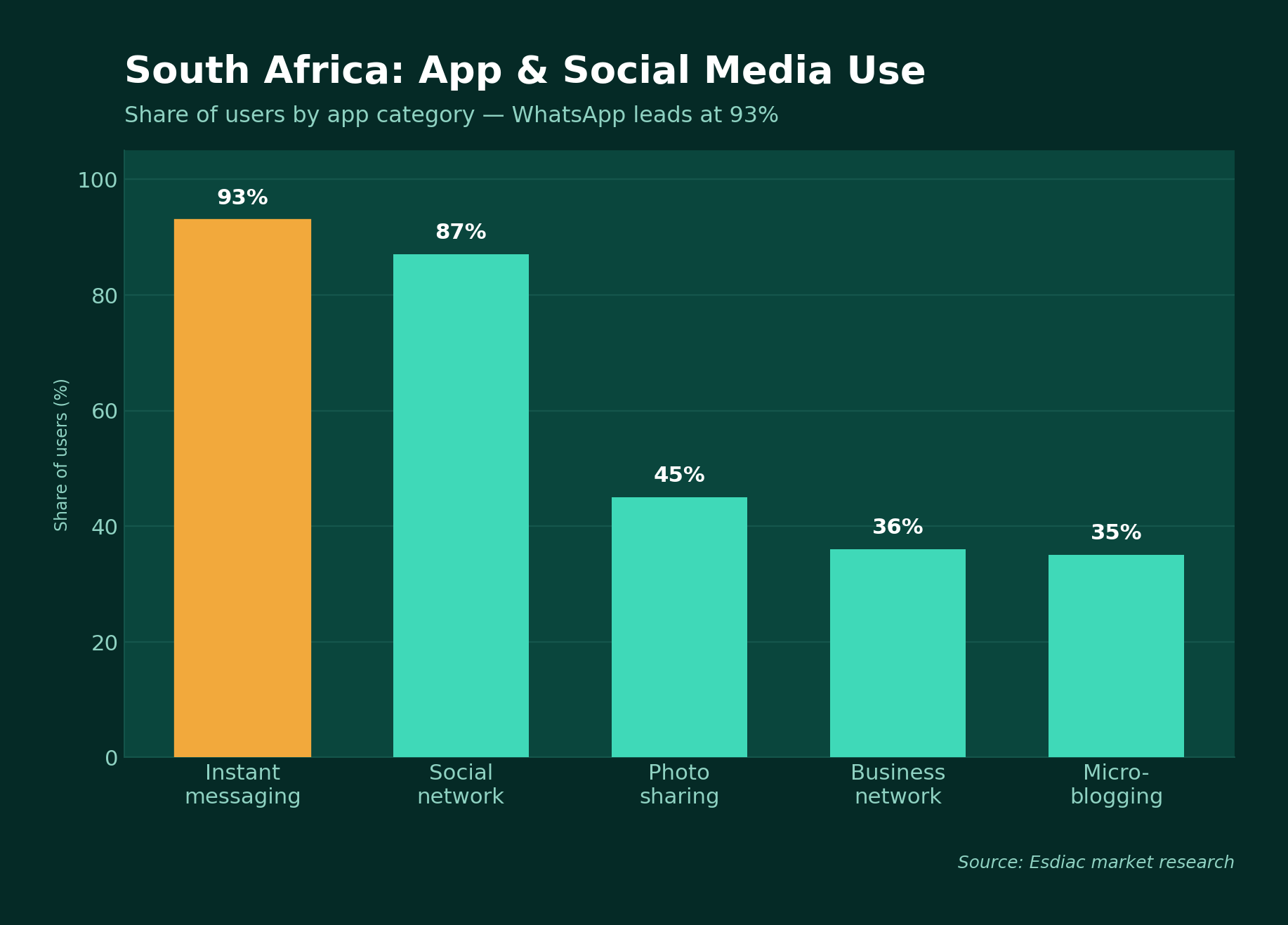
South Africa: app and social media use by category. Source: Esdiac research
Customer Profiles: Mexico
In Mexico, messaging and calling apps are used heavily — many users spend six or more hours a day on them. Notably, female users outnumber male users. Adoption is led by young adults (18–29), college graduates, and urban residents.
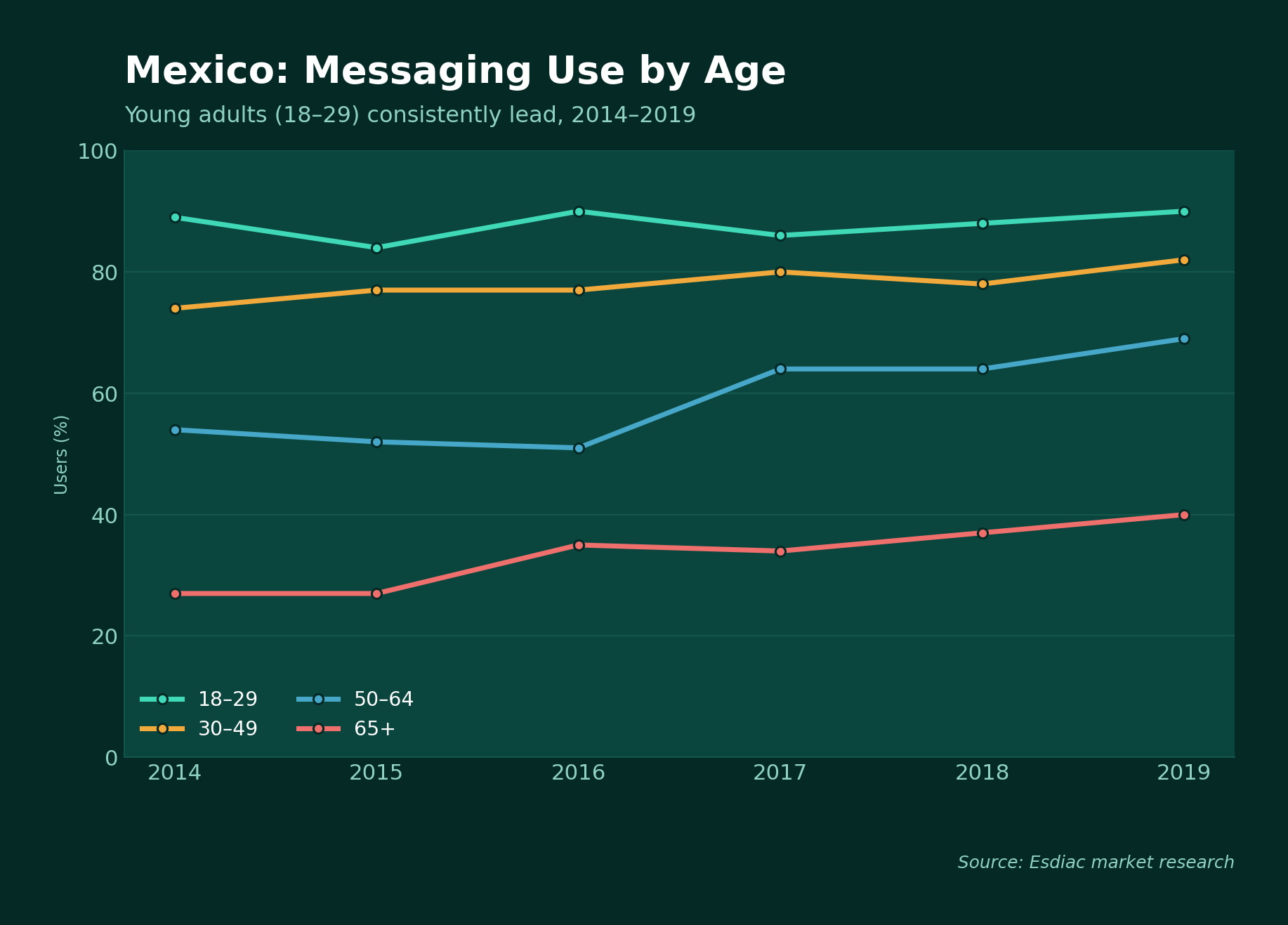
Mexico: messaging use by age group, 2014–2019. Source: Esdiac research
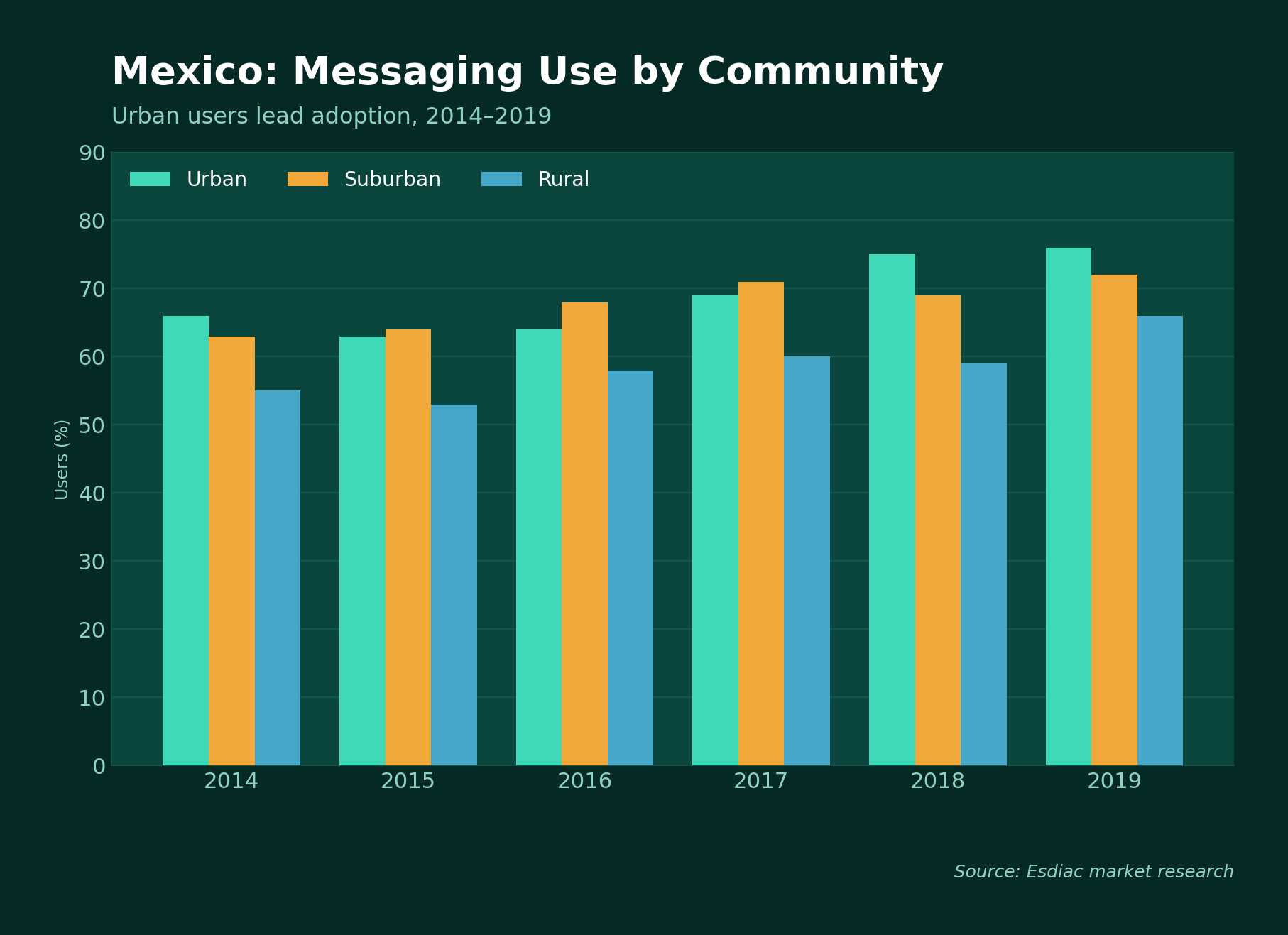
Mexico: messaging use by community, 2014–2019. Source: Esdiac research
Target Market
- Age: focus on 18–29 year-olds in both markets — the heaviest users.
- Gender: target female users in Mexico and male users in South Africa.
- Education: prioritize college-level and above users.
- Location: lead with urban populations, where adoption is highest.
Market Opportunities
Rising smartphone and internet adoption in both countries widens Esdiac’s potential base. South Africa’s smartphone users are forecast to climb toward 26M by 2023, while internet penetration keeps rising in both markets. Remote-work culture and improved scalability add further room to grow.
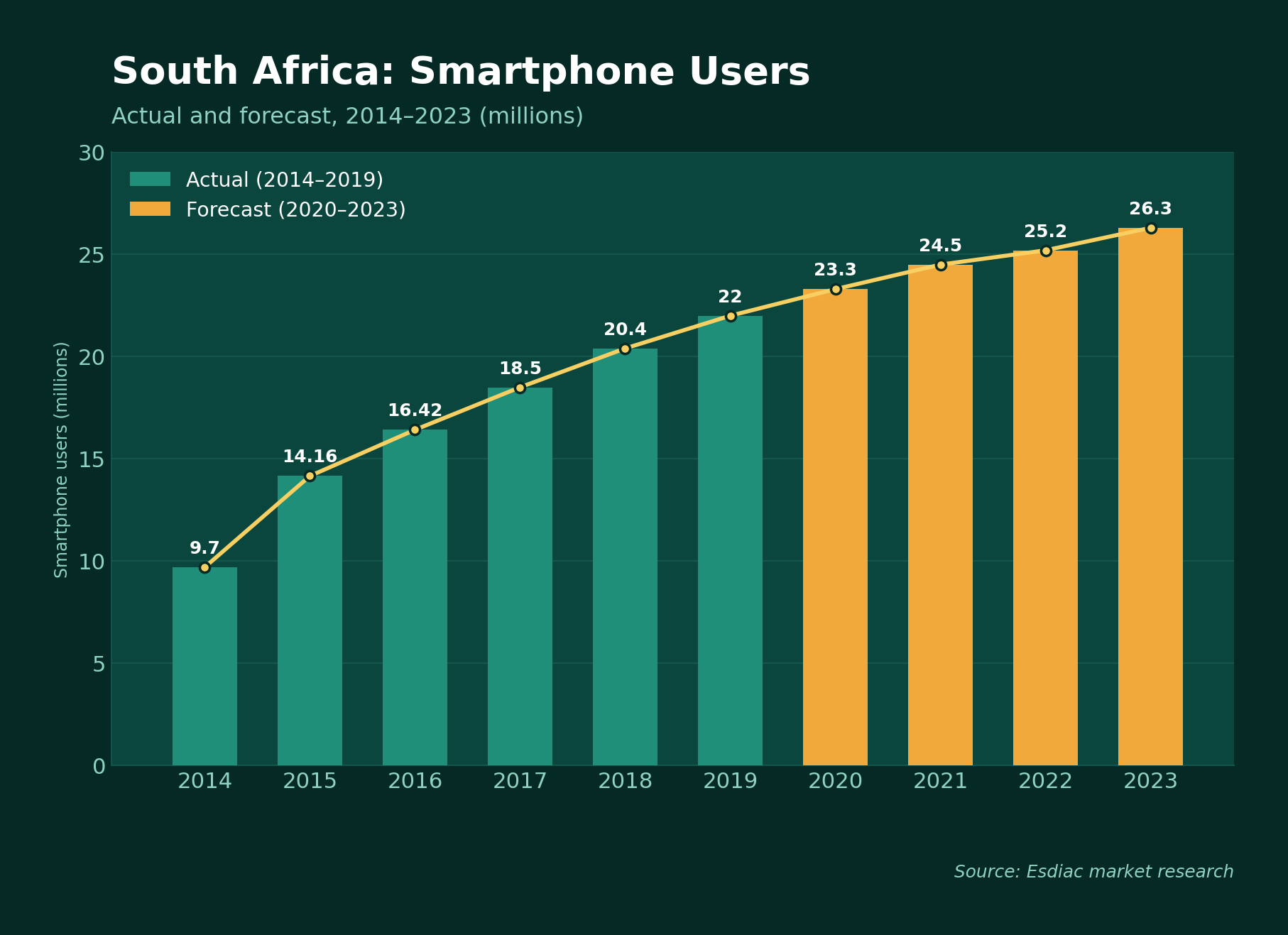
South Africa: smartphone users, 2014–2023. Source: Esdiac research
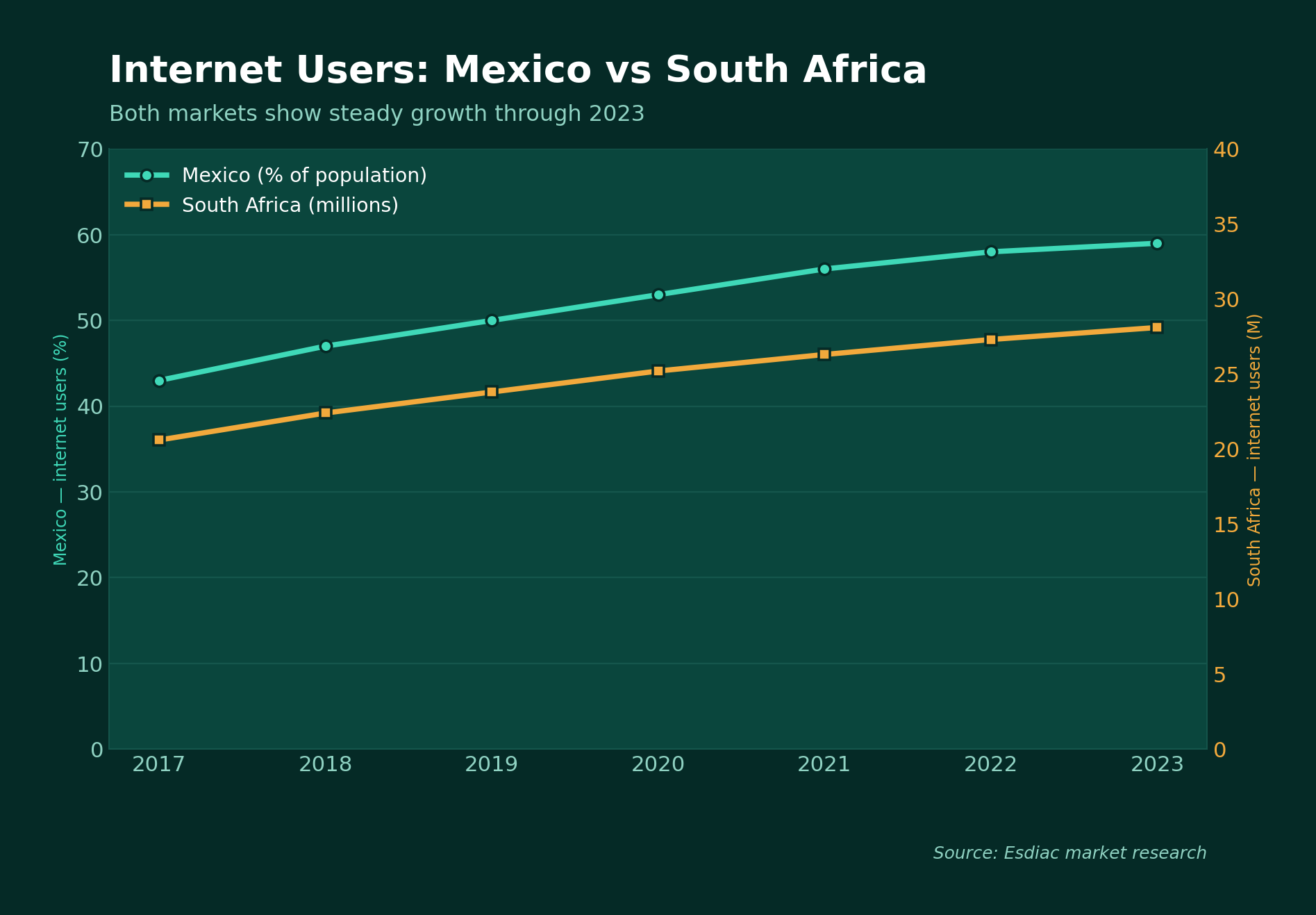
Internet users: Mexico (%) vs South Africa (millions). Source: Esdiac research
Threats
- Strong competition from WhatsApp, Viber, Skype, Messenger and others.
- Fast-moving technology raises the cost of keeping up.
- VoIP restrictions in some countries; security and privacy concerns.
- Uneven IT infrastructure (esp. South Africa) and political/economic uncertainty.
VoIP & App Trends
VoIP is maturing fast: in-app and unified communications are spreading, traditional landlines are fading, and 5G plus AI-driven customer service are entering the mainstream. Globally, app downloads are projected to more than double from 149B (2016) to 353B (2021), underscoring strong tailwinds for app-based calling.
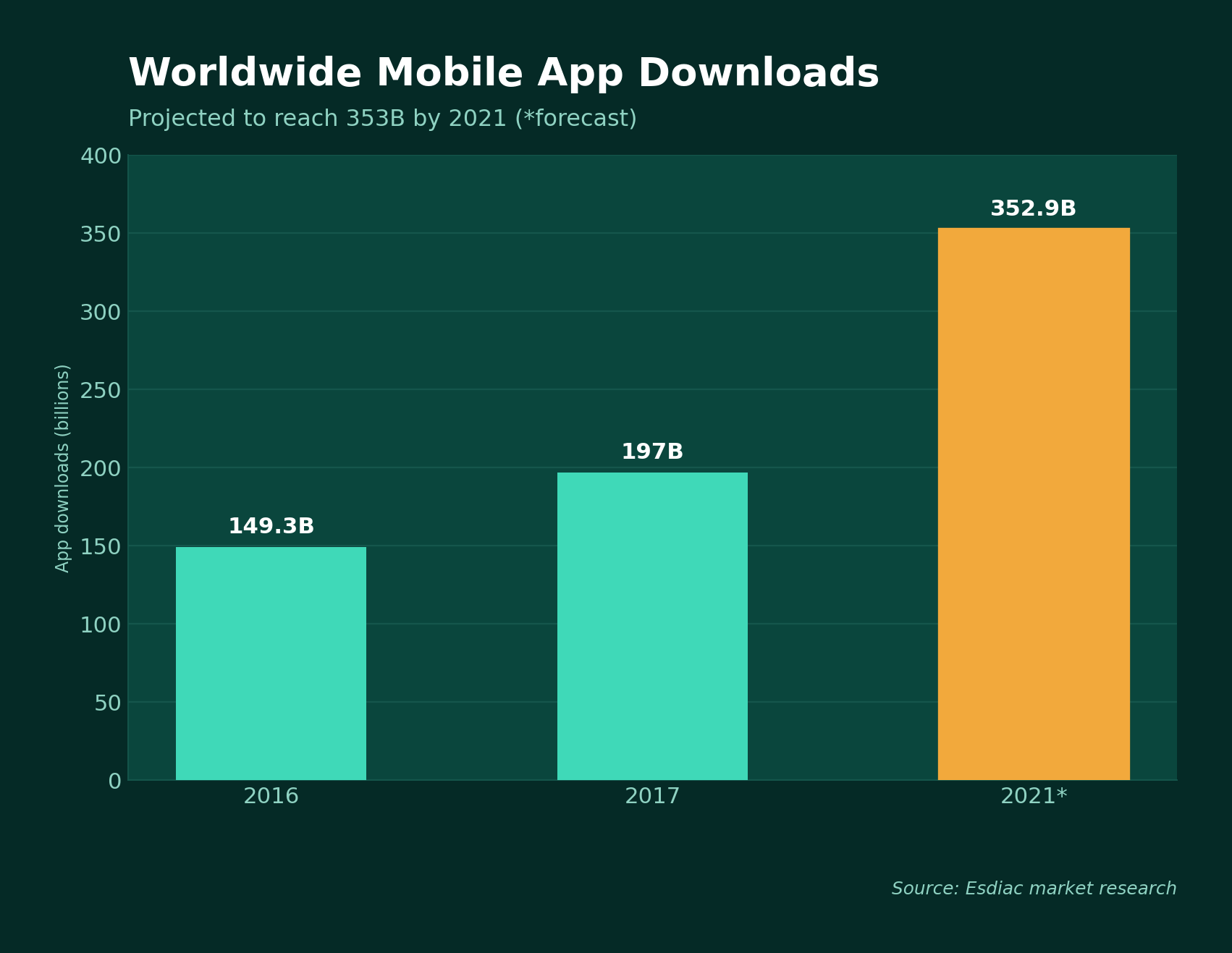
Worldwide mobile app downloads (billions). Source: Esdiac research
Competitive Analysis
Esdiac competes with established global apps. Its differentiator is the ability to call internationally to contacts who do not have the app, at low rates. Gaps versus rivals include group chats, chatbots, desktop/tablet support, and broader feature sets offered by WhatsApp, Messenger, WeChat, Snapchat, Viber, and Skype.
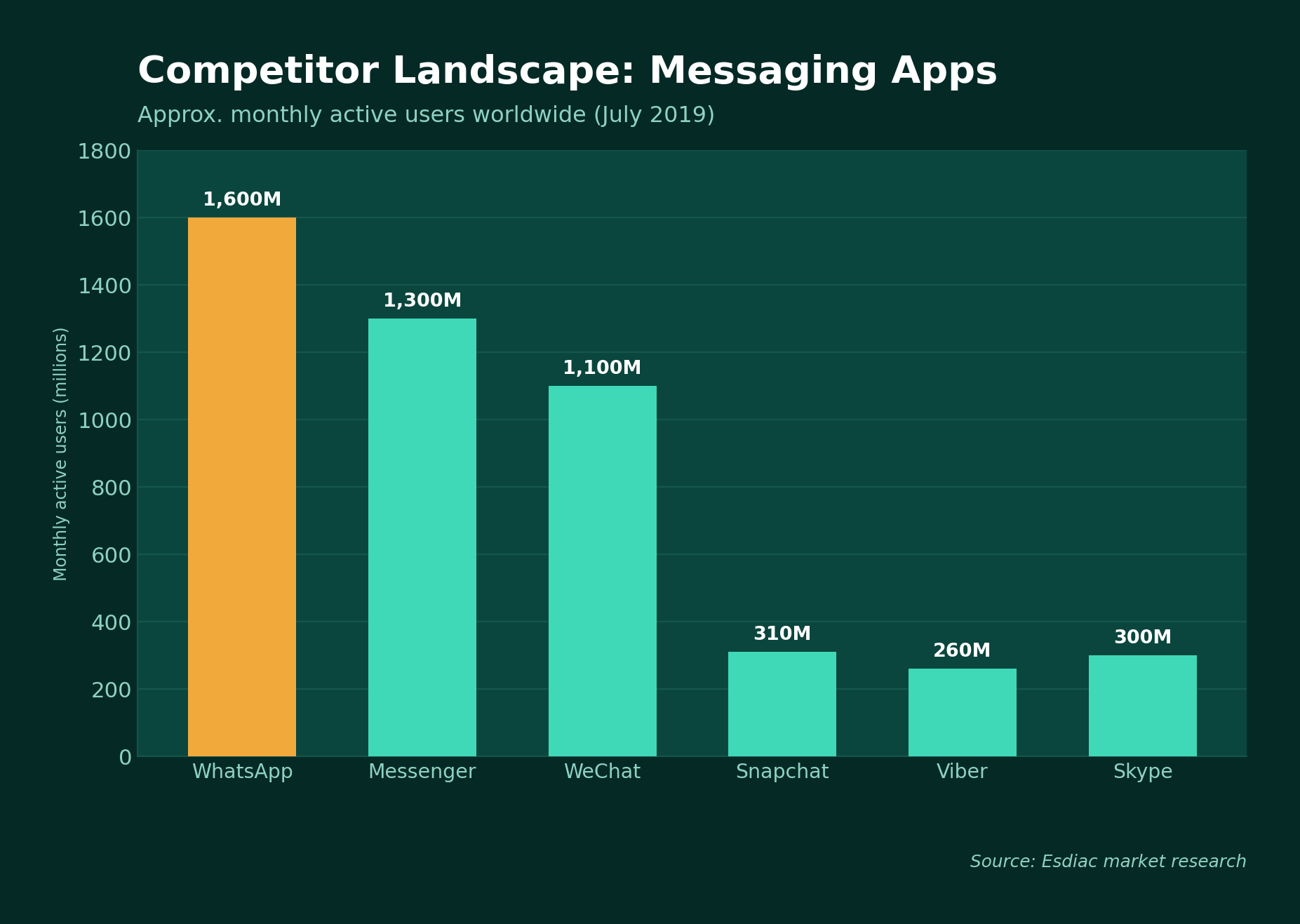
Competitor landscape: approx. monthly active users (July 2019). Source: Esdiac research
Esdiac vs Competitors — Snapshot
| Feature | Esdiac position |
| Low-cost intl calls | Strength — calls contacts even without the app |
| Group chats | Gap — not yet supported (rivals allow large groups) |
| Chatbots | Gap — no chatbot/automation features yet |
| Desktop / tablet | Gap — mobile only (Viber/Skype work cross-device) |
| Video quality | Competitive — high quality, but charged |
Growth Strategy
Lead with digital channels — social media and YouTube ads — supported by a clear, well-designed website. Use sign-up promotions (e.g. free calling credit) and rely on word-of-mouth from satisfied users. Back it with reliable 24/7 support staffed by skilled, adaptable, customer-friendly people.
Conclusion
Mexico and South Africa offer strong, growing markets for Esdiac, driven by rising smartphone and internet use and young, urban, educated audiences. Success depends on sharp targeting, closing key feature gaps versus rivals, and a digital-first, word-of-mouth growth strategy.